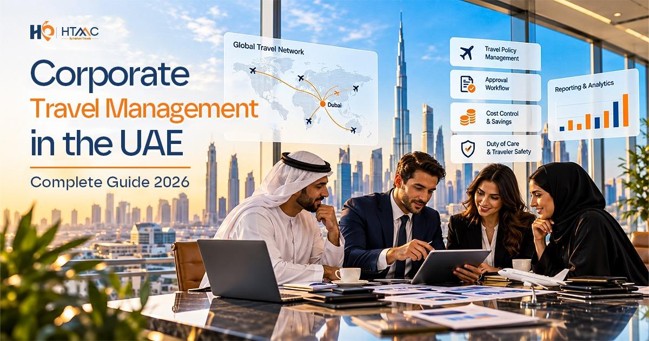
Here is what unmanaged corporate travel looks like at most UAE companies: an employee emails a travel agent, books the first available option, expenses it two weeks later, and nobody knows the total travel spend until the quarterly finance review.
It works until it does not. And by the time the numbers come in, the overspend is already locked in.
The UAE is one of the busiest corporate travel markets in the world. Companies headquartered in Dubai, Abu Dhabi, and across the Emirates send employees to London, Mumbai, Nairobi, Paris, and Johannesburg every week. The volume is high, the routes are complex, and the cost of getting it wrong adds up fast.
This guide covers what structured corporate travel management looks like, how to evaluate travel management companies, and what to consider when your company is ready to take control of its travel programme.
Why Corporate Travel Management Matters for UAE Businesses
Travel is typically one of the top three controllable expenses for any company. In the UAE, where cross-border travel is central to daily operations, the volume amplifies every inefficiency.
Without a managed programme, common problems compound quickly: employees booking at retail prices on consumer platforms, no enforcement of preferred suppliers, no consolidated reporting, and no emergency support when disruptions hit. Each of these is manageable in isolation. Together, they create a system that leaks money, creates risk, and gives management no visibility.
A structured approach does not mean adding layers of approval. It means putting the right systems in place so that travel happens efficiently, within policy, and with full transparency.
What a Managed Travel Programme Looks Like
Travel Policy Design
Every managed programme starts with a clear travel policy. This defines the rules: cabin class by seniority or trip type, advance booking requirements, per-night hotel budgets, preferred airlines and hotel chains, and approval workflows for exceptions.
A good travel policy is specific enough to enforce and flexible enough to accommodate legitimate business needs. A bad travel policy is a four-page PDF that nobody reads.
Online Booking Tools and Policy Enforcement
The policy becomes real when it is built into the booking platform. When an employee searches for a flight, the system automatically filters results by policy: preferred carriers first, within-budget options highlighted, out-of-policy fares flagged or blocked. Approval workflows route exceptions to the right manager before the booking is confirmed.
This removes the need for manual auditing. Compliance happens at the point of booking, not in a spreadsheet review after the trip.
Supplier Negotiation and Rate Access
A travel management company negotiates corporate rates with airlines, hotels, and ground transport providers on your behalf. TMCs aggregate volume across their client base, giving them leverage that no single company can match.
For UAE businesses, this is especially valuable on high-frequency corridors: Dubai to London, Dubai to Mumbai, Dubai to Nairobi, and the Schengen hub cities. Even a 5-10% improvement on negotiated airfares on these routes translates to meaningful savings at volume.
Spend Reporting and Analytics
Every booking generates data. A managed programme consolidates that data into reports that show exactly where the money is going: total spend by department, by traveller, by route, by supplier, and by policy compliance rate.
Finance teams use this to forecast and budget. Procurement teams use it to renegotiate contracts. Management uses it to hold the right conversations about whether travel spending is aligned with business priorities.
How to Choose a Travel Management Company in the UAE
IATA Certification and Accreditation
IATA certification is the baseline credential. It confirms the TMC meets international standards for financial stability, ticketing capability, and operational quality. Any TMC you evaluate should have this. If they do not, that is your answer.
Regional Presence and Local Expertise
This is where most evaluations get interesting. A TMC based in London or New York may have global reach on paper, but when your employee needs to fly from Dubai to Douala with a connection through Addis Ababa, you need a partner who actually knows that route, that airport, and the ground logistics on the other end.
For companies operating across the Middle East and Africa, regional presence is not a nice-to-have. It is the difference between a partner who can solve problems and one who can only report them.
Technology and Booking Platforms
The booking platform should handle flights and hotels at minimum, support multi-role access (employees, travel arrangers, finance approvers), enforce travel policy automatically, and generate spend reports without manual data entry. If your TMC’s “technology” is a shared inbox and an Excel tracker, you are not getting what you are paying for.
24/7 Support and Duty of Care
Travel disruptions do not wait for business hours. A flight cancellation at 11pm on a Friday is not less urgent because the office is closed. Your TMC must provide genuine round-the-clock support with experienced travel specialists who can rebook, reroute, and communicate, not an automated system that promises a callback on Monday.
Common Mistakes in Corporate Travel Management
The most common mistake is waiting too long. Companies assume they are “too small” for a TMC, when in reality, any company booking more than 15 to 20 trips per month is leaving money and control on the table.
Other frequent mistakes: writing a travel policy but never building it into the booking process. Choosing a TMC based solely on the per-transaction fee, ignoring the savings, service quality, and risk management they provide. Failing to track travel data consistently, which means the company cannot benchmark, negotiate, or identify waste.
Corporate Travel Management for Companies Operating in Africa
This is where generic advice breaks down. Africa is not one market. It is dozens of distinct markets, each with its own visa requirements, airline networks, hotel availability, airport infrastructure, and ground transport realities.
For UAE-based companies with operations in West, Central, or East Africa, the TMC they choose must have genuine regional capability. Not a partnership agreement. Not a call centre that covers the continent from a single location. Actual offices, with actual people, in the markets where your employees are travelling.
Key considerations for Africa-corridor travel include: multi-nationality visa processing that differs by embassy and by destination, limited direct flight options requiring creative routing through Addis Ababa, Nairobi, or Istanbul, hotel availability in secondary cities where international chains have limited presence, ground transport coordination from airport to site, and on-the-ground support when the inevitable disruption happens.
A TMC that manages African travel remotely from Dubai will give you bookings. A TMC with offices in Douala, Brazzaville, Dakar, and Nairobi will give you solutions.
How HTMC by Hariom Travels Manages Corporate Travel
HTMC by Hariom Travels delivers end-to-end corporate travel management designed for the realities of doing business across the Middle East and Africa.
With offices on the ground in the UAE, Saudi Arabia, Congo, Gabon, Senegal, Cameroon, Togo, Kenya, India, and the DRC, HTMC provides regional depth that remote-management models cannot match.
Services include travel programme design and implementation, travel policy enforcement through the HTMC Corporate Booking Tool, supplier negotiation and corporate rate access, spend reporting and analytics, MICE and events management, marine and offshore crew travel, visa assistance for 75+ countries, and 24/7 dedicated support with a named Account Manager for every client.
Contact our team to discuss your corporate travel requirements.